Exit Strategy: When the Green Man Does the Cinematographer’s Job
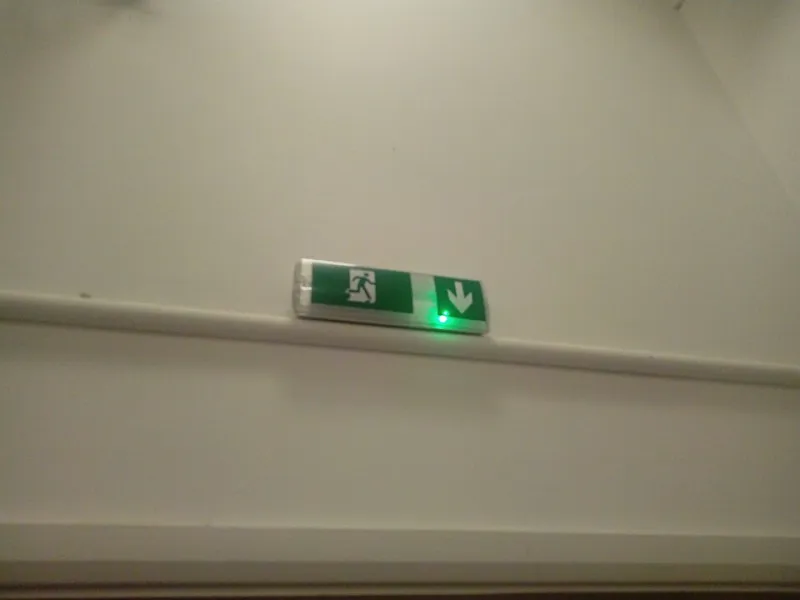
Photo: User:HarJIT, CC BY 4.0, via Wikimedia Commons
British films are full of light sources that nobody put there on purpose. The exit sign is the purest example: a small green rectangle, mandated by building regulations, bolted above a door, and somehow always in frame when a director needs a face to look worried. It is not a lamp. It is a legal requirement. And yet, in the right corridor, it becomes a key light.
At 51st Light we spend a lot of time noticing the light that was not invited. The exit sign is the great accidental auteur of UK cinema. It turns hospital corridors into holding pens, pub back rooms into traps, and multi-storey car parks into confessionals. Cinematographers curse it because it is green, uneven and often ugly. They also rely on it because it is already there, already motivated, and already telling the audience where the door is — even when the characters cannot get to it.
The Sign That Never Gets a Credit
The UK’s green running man is a piece of visual grammar we barely register. It is also a very specific colour: not the green of a forest, but the green of a circuit board that has been left in a fridge. It sits at the edge of the frame, hums quietly, and refuses to behave like a normal practical. You cannot dim it without a fire officer getting involved. You cannot move it without paperwork. So you shoot around it, or you shoot with it.
The best British films do the latter. They let the sign become a small, glowing punctuation mark. It says: this is an institution. This is a place with rules. And someone is about to break them.
1. 28 Days Later (2002): The Corridor Wakes Up
Danny Boyle’s post-virus London begins with a hospital corridor that feels less abandoned than switched off. When Jim wakes, the light is cold, dry and institutional, and the exit signs are among the few things still doing their job. That is the joke and the horror: the building has outlived its purpose, but the safety signage is still running.
The green glow gives the sequence a sickly pulse. It is not warm enough to be hope and not bright enough to be guidance. It just hangs there, above a door, while the world outside has stopped making sense. In a film full of aggressive visual choices, the exit sign is one of the quietest and most effective.
2. Shaun of the Dead (2004): The Pub’s Green Punchline
The Winchester is a British pub held together by beer mats, banter and stubbornness. When the group is locked in, the exit sign becomes both a practical detail and a punchline. It is the one bit of the building still promising a way out, and it is completely useless.
What works is the colour contrast. Pub interiors are amber, brown and nicotine-stained. The exit sign is a clean, regulatory green, like a health-and-safety memo pinned to a coffin. It makes the room feel less like a sanctuary and more like a waiting area. British cinema loves that kind of irony: the sign says exit, the story says no.
3. The Long Good Friday (1980): The Car Park as Confessional
Multi-storey car parks are British cinema’s least holy cathedrals. They are concrete, exposed, and lit by a mixture of sodium glow and emergency signage. In The Long Good Friday, the car park scenes have that unmistakable late-1970s Thames-side gloom: too much concrete, too little warmth, and the sense that the meeting was never going to end well.
The exit sign is not the star here, but it is part of the architecture of threat. It tells you where the ramp is. It tells you where the stairs are. It does not tell you whether you will get there. That is the British car park contract: visibility without safety.
4. Trainspotting (1996): The Toilet Door Threshold
Trainspotting is a film that treats interiors as chemical states. The toilet scene is famous for its filth and its plunge into the worst bathroom in Edinburgh, but the doorway light matters too. Fluorescents, stained tiles, a green sign above a door: the whole space feels like a place where dignity goes to be recycled.
The exit sign turns the threshold into a decision. It is not a warm invitation. It is a cold instruction. In a film about trying to leave things behind, the sign is almost cruel in its clarity. It says exit. It does not say how.
5. Kill List (2011): The Corridor With No Comfort
Ben Wheatley’s film is full of rooms that feel like they have been lit by whichever switch was closest to the door. Corridors, hotel rooms, anonymous interiors: the light is never generous. The exit sign fits perfectly into that grammar. It is a small green fact in a film that otherwise deals in bad decisions and worse weather.
What makes it work is the lack of glamour. There is no attempt to turn the sign into a moody neon sculpture. It is just there, doing its statutory duty, while the people beneath it do things that should not be lit at all.
Why Crews Curse It — and Use It Anyway
The exit sign is a nightmare for a gaffer with a plan. It is green, it is often uneven, and it can cast a strange vertical glow up a wall. It cannot be switched off without consequences. It cannot be gelled to a nice warm tone without looking like a mistake. But it is also free, motivated and utterly British.
That is why it keeps turning up. It is the visual equivalent of a council tax bill: boring, unavoidable, and quietly shaping the room. In 2026, with more productions shooting in real hospitals, schools and civic buildings, the green running man is only going to get more screen time. The trick is not to fight it. The trick is to let it do what it has always done: show us the door, and make us worry about who is standing in front of it.