The Half-Lit Stair: Five British Films That Found Drama on the Landing
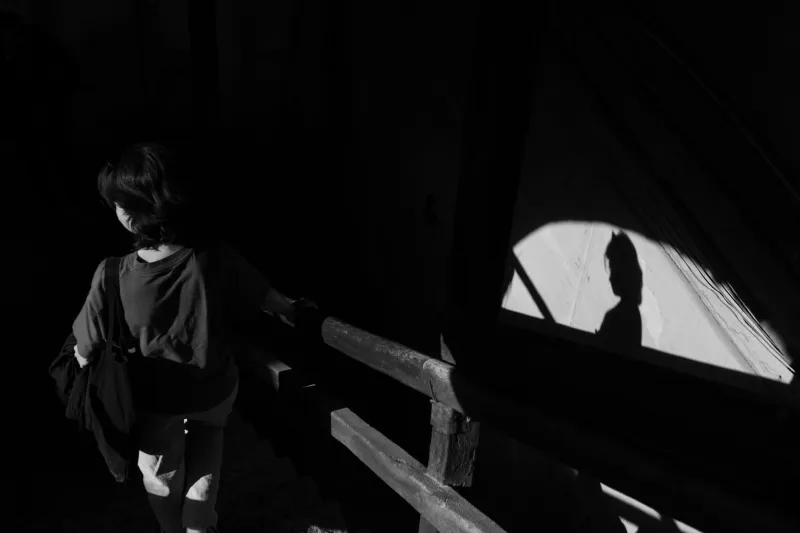
At 51st Light we spend a lot of time thinking about where light falls. Not just the big, obvious sources — the window, the streetlamp, the cinema screen — but the awkward in-between places. The half-landing. The turn of a staircase. The patch of wall that catches the glow from a downstairs hallway and throws it upstairs like a rumour.
British films have always understood that the stairwell is not a corridor. It is a pressure cooker. It is where the family argument spills out of the living room, where a lodger meets a landlord, where a child listens to adults through a banister. It is also, practically, one of the hardest spaces in British domestic architecture to shoot: narrow, low-ceilinged, often lit by a single borrowed bulb.
Here are five films that turn the landing into drama — and two UK crew members on how they do it.
1. The Servant (1963): the staircase as class battlefield
Joseph Losey’s film is full of polished surfaces and bad intentions. The Chelsea townhouse is a stage set for servitude, and the staircase is where the performance starts to slip. Barrett, played by Dirk Bogarde, ascends and descends with a tray; Tony, played by James Fox, sprawls. The landing becomes a place where the rules of class are tested in plain sight.
Douglas Slocombe’s black-and-white photography makes the stair look like a vertical class system. The camera can look up at power or down at vulnerability. The light from the hall below is always slightly too warm; the upper landing is always slightly too dark. It is domestic architecture as social anatomy.
2. Attack the Block (2011): the tower-block stairwell as chase cinema
Joe Cornish’s South London creature feature takes the stairwell out of the townhouse and into the council block. Moses and his friends race through fluorescent strips, concrete, graffiti and fire doors. The stairwell is not decor; it is the chase. The alien comes from above and below at once. The landings are ledges, the banisters are obstacles, and every flight of stairs is a new level of threat.
What makes it work is the way the architecture does the storytelling. The block feels vertical and endless. The stairwell is a maze with no exit, and the social realism of the location gives the monster movie a grounded, local charge.
3. His House (2020): the landing as haunting
Remi Weekes’s film puts Bol and Rial, a refugee couple, into a council house that is supposed to be a new start. The staircase is where the past seeps in. A hallway light under a door, a figure at the top of the stairs, the sound of something moving in the walls. The landing is a border between the life they want and the life they fled.
Here the stairwell works because it is a threshold. It is neither room nor corridor, so it can hold ghosts. The horror is not just in the dark; it is in the half-light, in the ordinary architecture of a British home becoming unfamiliar.
4. Saint Maud (2019): the staircase as revelation
Rose Glass’s film turns domestic space into a site of ecstasy and dread. Maud, alone on the landing of Amanda’s house, is lit from above like a figure in a painting. The stairwell becomes a church. The light isolates her; the shadows around her suggest something watching.
Ben Fordesman’s cinematography understands that a single top light on a landing is a spotlight. It turns a few square feet of carpet and banister into a stage for devotion and delusion. The stair is not just where Maud walks; it is where she is revealed.
5. The Nest (2020): the staircase as aspiration
Sean Durkin’s film places Rory and Allison in a large house in 1980s England, and the staircase is the family’s statement of arrival. It is polished, wide, expensive. Then it becomes the place where the statement falls apart. Arguments on the landing, a child listening, the camera at the bottom of the stairs looking up.
The stair is a promise. The landing is where the promise is tested. It is a very British kind of drama: polite architecture, impolite feelings.
The craft: shooting the British stairwell
I spoke to a London-based production designer and a cinematographer who have both worked extensively in UK domestic locations. Both asked not to be named — freelance crew are careful about saying which houses are difficult — but their notes were practical.
The production designer’s first point: British stairwells are narrower than the ones in American films. “You cannot cheat scale,” she said. “A Georgian terrace has a different rise and run from a 1930s semi, and a council block has different fire doors and different ceiling heights. If you pretend they are the same, the audience feels it.”
That means the design has to work with the architecture, not against it. A half-landing is a gift for blocking: it gives you two levels in one frame, a natural place for a character to pause, and a built-in power dynamic. But it also means you have to think about where the light comes from. “You are often relying on borrowed light,” the designer said. “A transom window, a landing light, a bit of spill from the kitchen. You can’t just put a big source in the corner.”
The cinematographer’s advice was about restraint. “The temptation is to light the whole stairwell so you can see everything,” he said. “But then you kill the scene. A landing works because it is half-lit. You want the top of the stairs to be a question mark.”
Practical lessons:
- Use the practicals. A bare bulb, a cheap shade, a hallway light left on downstairs. They motivate the shadows.
- Shape from above. A single source over the landing can create a pool of light and a dark turn.
- Negative fill is your friend. Flags and black cloth on the walls stop the light from wrapping.
- Smoke or haze helps. It gives the beam something to catch.
- Safety first. Stairs are a rigging nightmare; plan the camera move before you fall down them.
The last step
The stairwell is a small space with a big job. It has to be a corridor, a stage, a hiding place, a social ladder. In British cinema it is often the place where the film stops being polite. The living room is for conversation; the landing is for the truth.
And that, at 51st Light, is what we mean by shadow and light. Not just the look of a scene, but the architecture of it. The half-lit stair is where the drama waits.