Paint It Dark: Five Hand-Brushed Shadows That Still Beat a Colour Grade
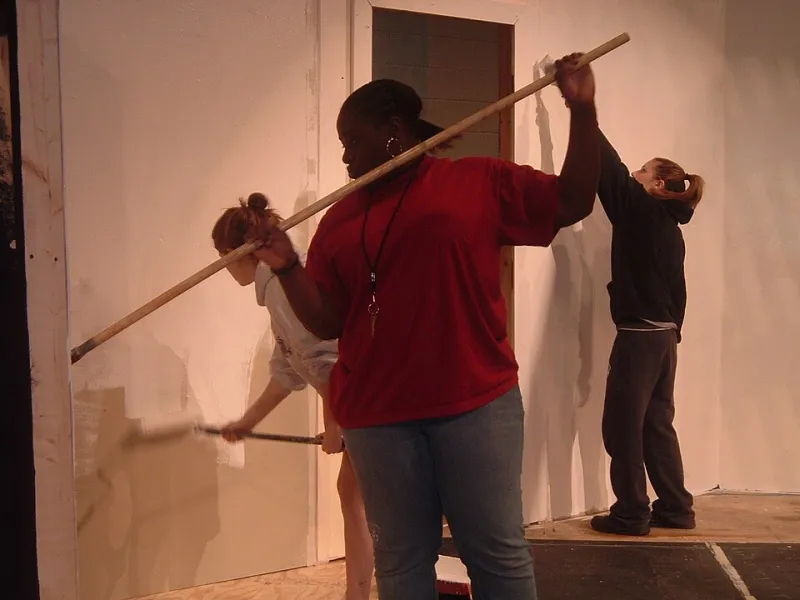
Photo: KeepOnTruckin, Attribution, via Wikimedia Commons
There's a smell in a scenic workshop that gives it away before you see anything: size, pigment, and hot lamps drying a flat. Somewhere at the back, a cloth the size of a tennis court is pinned out on a frame, and a painter is standing on it in socks, brushing in a window that isn't there.
Hand-painted scenery has been pronounced dead roughly every decade since the 1960s. It survives because cameras are literal machines. A shadow that was painted on a wall at the right time of day, in the right direction, with the right edge, is in the room. A shadow added in post is a calculation. Audiences may not know the difference consciously, but they feel it — and so, increasingly, do directors who've been burned by a night exterior that looks like a filter.
Here are five techniques still in daily use in British workshops, from regional reps to the big paint frames, and why each one earns its keep.
1. Sponged Soot: The Grime Pass
The oldest trick in the building. A base coat goes down, then a stipple sponge — natural, torn, so the holes aren't uniform — is dabbed in a thinned black-brown and worked up from the floor line, round door frames, under windows. The result is a graduation of dirt that follows how the building would actually have been used.
Why it beats a grade: grime in post tends to sit on top of the image like a layer of gauze, uniform and slightly flat. Painted soot has direction. It's darker where a hand would have touched and lighter where rain would have run. Under a hard side light it casts its own micro-shadows, which is exactly the kind of detail that makes a close-up convincing. Aged walls on a standing set will get this pass twice — once for the build, once again mid-run, when the real dirt starts to arrive and the painter has to blend in.
2. Brushed-In Window Light: The Ladder on the Wall
On a theatre flat or a studio wall, the illusion of a window is mostly a set of parallelograms. The painter marks out the frame's geometry using the actual light position on set, then brushes in soft bars of warm white with a badger blender, feathering the edges so they fall off rather than stop.
Get it right and an actor can walk through a patch of painted sun and it reads. Get it wrong and it's a stripe. The skill is in the falloff — most scenic artists will build the same bar three or four times, each pass drier than the last, until the edge disappears into the wall the way real light does at the corner of a room. On camera, a practical lamp hitting a painted bar of light looks like a room; a practical lamp hitting a blank wall looks like a set.
3. The Cast Shadow of an Unseen Object
This is the connoisseur's favourite. A shadow across a floor and up a wall, cast by something the audience will never see — a lamp post, a railing, a person standing at the door. It's painted in cool grey, stretched and skewed to match a light source that may not even exist in the scene.
Because the shadow implies an off-screen world, it does an enormous amount of storytelling for the price of a tin of paint. It also solves a boring practical problem: a real lamp casting that shadow would need a rig, a stand and a hole in the budget, and would probably flare. The painted version costs an hour and a half and a steady hand, and the camera accepts it without argument in a wide shot. Regional theatres use it constantly for interiors that need to feel like they're in a street rather than a box.
4. Moonshine on the Cyclorama
Faking a night sky on a cloth or cyc is a two-part job. First comes the wash: a blue-grey base, often mixed with a touch of raw umber so it doesn't go purple under tungsten. Then the moon side — a dry brush, very little paint, dragged lightly across the surface to suggest a cool, low light grazing the top of a wall or a hedge.
On a well-painted cloth the effect survives being lit from different angles during a run, which is the point. A digital night look is locked to a specific grade; a painted one responds to the lighting state, so a slow fade at the end of an act still looks like night rather than a dimmed picture of it. It's the difference between a thing that's dark and a thing that's lit by the dark.
5. Smoked Glass: The Painted Matte
A piece of optical glass, cleaned, then worked with a spray gun, a rag and a brush to hold a soft dark shape — a hillside, a row of rooftops, the blur of a tree. Held a foot or two in front of the lens, it puts depth into the background without a single pixel being generated.
This one is beloved by crews doing period television on tight schedules. The glass can be tweaked with a thumb on the day, it never aliases, and it moves the way real atmosphere moves because it is real atmosphere — the light passes through the marks. When the focus is pulled, the smoke softens exactly as it should. No amount of digital haze does that convincingly at a low budget.
The Brush Beats the Slider
None of this is a rejection of post-production. Every one of these sets will still go through a grade. But the painted work gives the colourist something real to work with — ridged texture, uneven tone, edges that behave — rather than a flat canvas waiting to be rescued.
If you're building anything that has to look lived-in on a British budget this year, the cheapest fix isn't a plugin. It's an afternoon with a scenic artist, a badger blender and a torn sponge. Ask around any regional theatre's paint frame and you'll find someone who's been quietly doing it for thirty years, and who'll tell you the same thing every time: the camera can smell a fake shadow. So paint it properly.