Where the Grain Lives: Inside the UK Labs Still Developing Britain's Celluloid
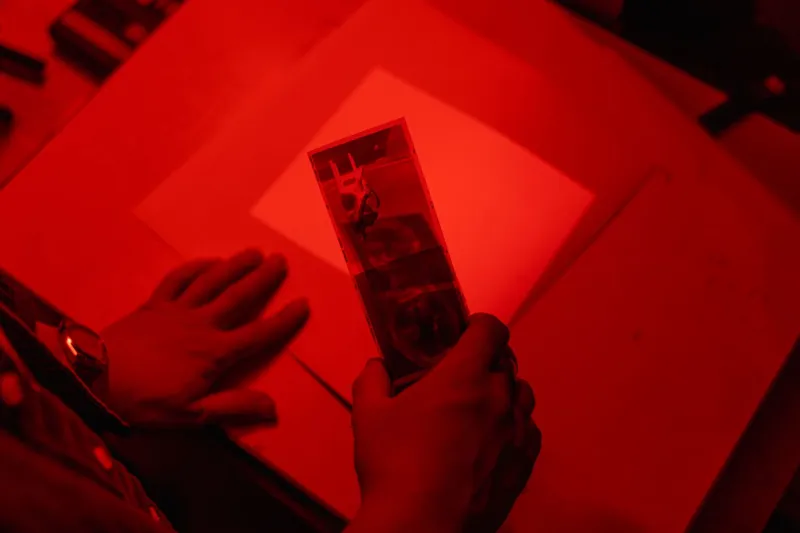
A Tuesday morning in Slough, and the air inside the building smells of fixer, warm dust and something faintly vinegar-sharp. On a bench, a 400ft roll of 16mm is being wound by hand. It arrived overnight from a shoot in Peckham — a music video, three minutes long, made for roughly the price of a decent second-hand car — and by Thursday it will exist as a scan, a grade and a set of files that can travel anywhere in the world. But first it has to be developed, and that is why the roll is here, on a bench, instead of in a folder on somebody's desktop.
This is what the analogue revival actually looks like up close: not a wave of nostalgia, but a queue.
The rooms that never quite closed
Britain's film-processing infrastructure is smaller than it was in its Nineties pomp, but it is not gone. A handful of facilities still handle motion picture stock at commercial scale — Cinelab London out towards Slough, Digital Orchard in the Chilterns, i-Dailies in the capital, plus a scattering of specialists who will hand-develop a short if you ask nicely and pay promptly. For a decade these places survived on archive work, restoration and the occasional prestige feature. Then the phones started ringing again.
What changed wasn't a single film. It was the accumulation of them — features shooting 35mm because a director wanted a particular fall-off in the highlights, adverts booking 16mm for the texture, promos using short ends because the budget wouldn't stretch to a full can. Add the steady drip of film schools and BFI NETWORK shorts insisting on a celluloid component, and you get a workload that a five-person lab feels in its shoulders.
“We can absorb a busy month,” one scanner operator tells me, sleeves pushed up, “but we can't absorb a busy year. The machines are old. The people who know how to fix the machines are older.”
Why directors keep coming back
The honest answer, in 2026, is that film is no longer a statement of purity. It's a tool with a personality. Shooting digital gives you a clean, obedient image; shooting 16mm gives you one that argues back. Halation blooms around a practical lamp. Grain moves in a way that no plug-in quite matches, because it's random in the way weather is random. And crucially, the negative doesn't flinch — you can overexpose a window and still find detail in the scan that a digital sensor would have surrendered.
For music videos and shorts, that personality is the whole point. A three-minute promo has no room for a five-day lighting plan; it has room for one strong idea. Film makes that idea feel like an artefact rather than content. Directors talk about the discipline of it: eleven minutes per roll, no monitor to hide behind, a crew that knows the take matters.
There's also the shadow side, literally. Colourists describe grading film as a different craft — you're shaping a density curve rather than fighting clipped highlights, and the blacks have a softness that reads as atmosphere on a phone screen. In an era when everything is designed to survive compression, that softness is a competitive advantage.
The arithmetic of celluloid
Nobody pretends it's cheap. Stock alone on a short can run into four figures once you've factored in processing and a 4K scan, before a single lamp is rigged. Labs are candid about it: the revival is real but narrow, concentrated in projects where the texture is worth the spend — a heritage brand film, a horror short that needs the fear to feel found rather than manufactured, a feature that wants a specific era's colour response.
And there's a subtler cost: time. A digital rushes workflow means you see last night's footage over breakfast. Film means you see it when the lab sees it, and the lab has other people's reels ahead of yours. Directors who shoot celluloid learn to plan like people who can't check their work — which is, arguably, how everyone used to work, and not the worst habit to rediscover.
The lab as co-author
What surprised me most is how much authorship a good lab has. A dailies colourist who has spent twenty years on a telecine bench can tell you within seconds whether a negative was rated honestly, whether the lab that processed it rushed the developer, whether the DP was trusting the stock or fighting it. They'll flag it, quietly, and the production will listen.
That relationship — technician as collaborator rather than vendor — is the thing most at risk. The knowledge is oral. It gets passed on by standing next to someone for a year. Every lab I spoke to mentioned the same anxiety: not demand, but succession.
The poetry of imperfect light
The revival isn't really about grain. It's about a working method that accepts imperfection as part of the image rather than a fault to be corrected. A light leak is a decision you didn't make and now have to live with. A slight weave in the frame is a reminder that a machine pulled the film through a gate. In a pipeline that increasingly promises total control, that small surrender feels like relief.
On the bench in Slough, the roll from Peckham gets spooled, logged and taken away. Somewhere in those eleven minutes is a performance that only happened once. The lab's job is to make sure it survives the trip into the light. That it does, week after week, in a handful of rooms across Britain, is a quiet piece of good news for anyone who cares what cinema looks like.