Amber and After: What Britain's Orange Streetlights Did to the Movies
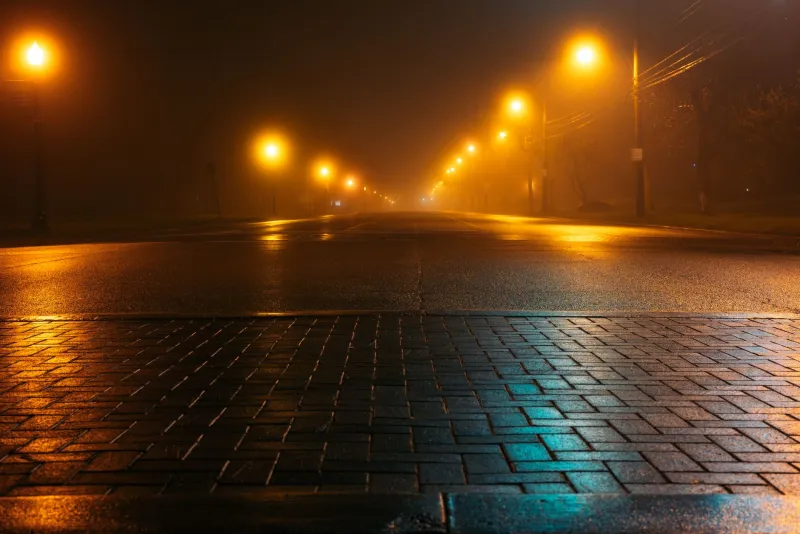
There's a specific orange. Not sunset orange, not the orange of a warning sign. It's the flat, dusty apricot of a low-pressure sodium lamp doing its one job, and if you grew up in a British town between about 1975 and 2015, it is probably the colour of every memory you have of being out too late.
Sodium vapour lighting arrived on UK roads in the 1960s and spread through the following decade, first on trunk roads and then into housing estates, ring roads and the long walk home from the bus stop. It was cheap to run, remarkably efficient and utterly monochromatic — low-pressure SOX lamps emitted almost everything at around 589 nanometres, which is a technical way of saying: orange, and nothing else.
For filmmakers, that was either a catastrophe or a gift, depending on the script.
A lighting rig nobody had to pay for
The great thing about a sodium street is that it does half the art department's work. The lamps throw hard, low-slung pools with real darkness between them. They fall off fast, so a pavement becomes a series of islands. Faces get top-lighting with an ugly, beautiful rake to it — cheekbones come up, eye sockets go to mud, and everyone looks like they're keeping something.
As one veteran gaffer put it to me, half-joking: "You didn't have to motivate anything. The street motivated it for you. You just had to be standing in the right puddle of it."
Because SOX is nearly single-wavelength, colour negative shot under it without correction goes orange to the point of abstraction. Reds vanish into it. Blues die. Skin goes a strange, waxy bronze that no make-up department could ever convincingly fake. Correct it out with a heavy blue filter and you lose two stops of exposure you probably didn't have in the first place. So most people didn't correct it. They leaned in.
That decision — accept the amber, let it be the world — is the origin of a lot of what we now think of as the British night look.
The city as a circuit board of amber nodes
You can trace the aesthetic through the 1970s and 80s without much effort. The long, wet arterial roads of London thrillers, the stairwells of tower blocks, the pub car parks. Performance and The Long Good Friday both understand that a British city at night is not a neon city; it is a city of dull orange punctuation marks with a great deal of black in between. Mona Lisa pushes a character through that wash and lets the colour do the loneliness for it.
By the 1990s the grammar was second nature. Nil by Mouth, shot with an eye for available light and hard practicals, uses the colour as part of the fabric of a place rather than as decoration. Later, the estate thrillers and South London genre pictures of the 2000s inherited the same instinct: put the actor in the one working lamp, let the rest go.
What sodium gave cinematographers was contrast for free. Not contrast of colour — there wasn't any — but contrast of intensity. A frame could be 85 per cent near-black and still read, because the eye forgives an underexposed orange face in a way it never forgives an underexposed blue one. Shadow became cheap to shoot. Shadow became the point.
The LED handover
The change came quietly, council by council, from around 2013 onwards. Street lighting authorities across the UK swapped sodium for LED, driven by energy costs, maintenance cycles and carbon targets. Some went further and introduced part-night lighting, switching whole stretches off between midnight and dawn.
LED is better at almost everything. It lasts longer, it dims intelligently, it directs light downwards rather than spraying it, and properly specified it reduces skyglow. On a residential street the modern warm-white unit sits somewhere around 2200K, which is closer to sodium than the icy 4000K of an early main-road retrofit.
But it is not the same. LED is broader in spectrum, so it renders colour again — you get blues back, you get reds back, you get skin that looks like skin. And it is even. That's the real loss. Sodium was patchy, unfair and full of holes. It made a street look like a series of accidents. LED makes a street look like a diagram.
A focus puller I spoke to described the difference bluntly: with sodium, she said, you were always chasing somebody through the dark and catching them for a second. Now, on a newly relit road, "there's nowhere to hide and nothing to find. It's just lit."
What to do about it
Two approaches, and both are legitimate.
The first is reproduction. You can rebuild sodium convincingly with 2000K-ish LED units, a warm gel such as a chrome orange, and a bit of restraint about spill. Do it badly and you get a music video with an orange filter over the lens. Do it well and you get the falloff right — the darkness between the lamps, the way the colour dies six feet from the kerb. Reproduce the physics, not the hue.
The second is to stop mourning and use what's there. The current British night is a mixed-temperature mess: warm-white residential, cold-white arterial, blue-white shopfronts still blazing at 2am, the green-white of a bus shelter. That mess is honest, and it is this decade's version of the same accidental palette. Some of the most interesting work being shot in the UK right now leans into the clash rather than smoothing it away.
Shoot it while it's still there
There are still pockets of sodium out there. Rural authorities with a stock of spare lamps, private roads, industrial estates, the backs of retail parks where nobody has got round to the upgrade. It's worth a scout. Not out of nostalgia — the light is genuinely different in a way that's hard to fabricate, and once it's gone it's gone.
Street lighting is the largest unpaid lighting rig in the country, and nobody ever wrote it a credit. It gave British cinema a colour, a mood and a reliable way to make a small budget look deliberate. The least we can do is notice, in the last few years of the amber hour, what it was doing for us all along.