Lamps, Limits and the Long Shadow: Three British Gaffers on Learning to Light Less
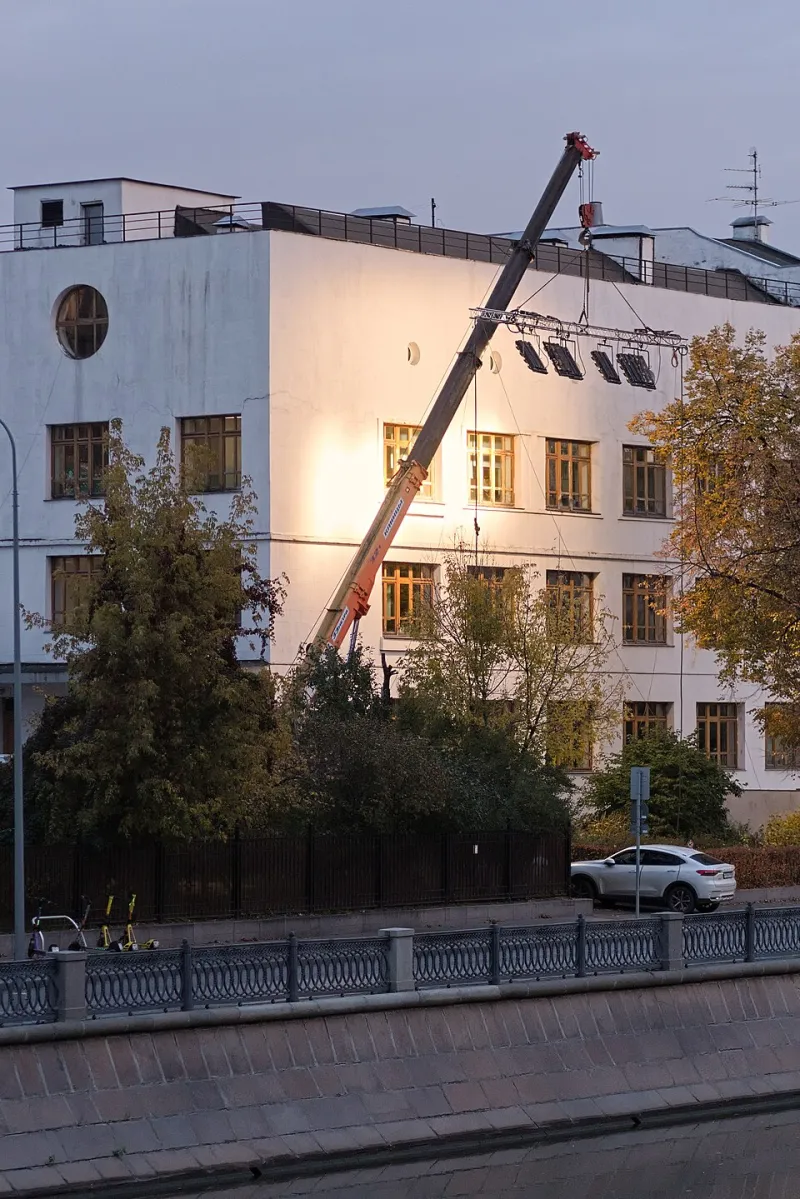
Photo: Retired electrician, CC0, via Wikimedia Commons
There is a moment on every set when the lighting stops being technical and starts being a decision about what the audience is allowed to feel. Nobody announces it. The gaffer just walks into frame, squints at a patch of wall, and asks for a flag.
We wanted to talk to the people who make that call. Not the ones with the awards reel and the fragrance ad campaign — the ones who turn up at 6.40am in a Transit with a van full of lamps and a plan for how grief should look on a 35mm print. Three gaffers, three cities, three very different sets of constraints. Some names have been changed, because two of them are mid-shoot and one is superstitious.
Cardiff: Cerys and the ceiling bounce
Cerys Llewellyn has been chief lighting technician for eleven years, most of it in and around the Bay, with a run of Welsh-language drama and two features that never quite got the release they deserved. Her signature, if she has one, is ceilings.
"People think lighting is about what you point the lamp at," she says, sitting in a Roath café that has been used as a location so often she's stopped noticing. "It's about what you point it at instead. Nine times out of ten I'm not lighting the actor. I'm lighting the polystyrene tile above the actor and letting it fall on them like weather."
Her kit reflects that. Two 300W tungsten fresnels, a couple of LED panels she describes as "fine, if you don't ask them to do anything interesting", a box of diffusion, and an enormous amount of black cloth. When a production has money, she buys blackout. When it doesn't, she buys more blackout. The most useful thing in her van, she reckons, costs about forty quid: a roll of heavy-duty duvetyne.
"Everyone wants a new light. Nobody wants to spend the day stopping light getting in. But if you can kill the window, you can own the room, and then one lamp is enough."
Her frustration is specific and familiar. British crews are world-class at making a little go a long way, and then a streamer arrives, wants everything flat and bright so it plays on a phone in a bus, and the shadow goes out of the work.
"You can always tell when a producer has watched a telly show and got nervous," she says. "Suddenly everything's at 60 IRE and nobody's face means anything."
Glasgow: Dougie and the dreich
Dougie McAllister works out of Govan and has spent a decade learning to imitate Glasgow's most reliable lighting designer: the sky. Flat, low, luminous, occasionally furious.
"Dreich is a technical term," he says, deadpan. "It's between drizzle and despair. You can't fake it with a blue gel. It's a big soft source, it's slightly green, and it's got no direction at all. It makes tenements look like paintings."
His workaround on a low-budget short is a 8x4 sheet of white poly, a single 2kW bounced into it from forty feet away, and an unembarrassed willingness to shoot at the times of day when the sky is doing the work for free. He calls the last one "the biggest lamp in Scotland", and he means it — he will fight for a 4pm call to get a corridor of light down a close rather than spend three hours rigging one.
"The thing nobody tells you is that light has a direction and the direction is a story. If the light's coming from above and outside, people look small. If it's coming from a lamp they've switched on themselves, they look like they're in charge. Most of my job is deciding who's in charge of the room."
He's candid about the pressure that comes with darkness as a style. On a recent crime series, notes came back that certain scenes were "too murky" for a co-production partner. The fix wasn't more light — it was more shape. "We raised the exposure on the faces and dropped everything behind them. Same mood, better separation. That's the trick. You don't get brighter, you get clearer."
London: Priya and the practicals
Priya Raman works out of a unit near Three Mills and came up through pop promos and music videos, which is why she is unbothered by a lack of gear and mildly obsessed with what's already in the room.
"Practical lamps are the closest thing we've got to found objects," she says. "A table lamp, a strip light in a launderette, the green emergency box above a fire door, the fridge. If the audience believes the room is making its own light, they stop asking questions and start feeling things."
Her method on a recent no-budget feature: swap every practical bulb for a higher-wattage, lower-temperature version, then dial down the camera and let one motivated source carry the frame. The rest is negative fill — black on the shadow side, so faces get depth instead of wash.
She is also the most direct of the three about the thing young filmmakers get wrong.
"They bring twenty lamps to a two-lamp problem. Then everything's lit from everywhere and nothing's lit. Somewhere around your fifty-first source the image stops being lit and starts being flooded. Fifty-first Light is a good name for a website and a terrible name for a lighting plan."
The unglamorous craft
All three describe the same job in the same shape: read the script, decide what the light is doing in the story, then find out how few sources can honestly do it. None of them talk about beauty. They talk about honesty and separation and where the eye goes.
That's the gap in how we talk about British filmmaking. We celebrate writing, we interview directors about intent, and we treat the look of a film as if it arrived by weather. But the flat grey of a Tuesday afternoon in a Leeds flat, the sodium bleed over a night bus, the one warm bulb in a cold kitchen — those are authored. Someone chose them, and usually that someone was standing in the rain at 11pm holding a piece of black cloth and a roll of gaffer tape.
What a young filmmaker can steal
- Buy blackout before you buy a new lamp. Killing light is cheaper, faster and more dramatic than adding it.
- Decide who owns the room. Every scene has a source. Find it, motivate it, and let the rest fall off.
- Expose for the face, protect the shadow. Murk and mystery are two different things.
- Bounce, don't blast. A sheet of poly and a wall will do more for you than a bigger fixture.
- Shoot the sky. British weather is a free 20x20 softbox with a colour temperature nobody in a studio can imitate.
- Test on the actual camera at the actual stop. Everything looks lovely at f/1.4 on a monitor in a warm room.
The best lighting in British cinema is not the lighting you notice. It's the reason you were afraid, or hopeful, or convinced that a man standing in a doorway had made a decision he couldn't take back. That happens in the dark, with a bit of cloth, on a budget, in the rain. Which is, when you put it like that, quite a British craft after all.