Under the Tubes: How the Chip Shop's Awful Light Made British Cinema Look Honest
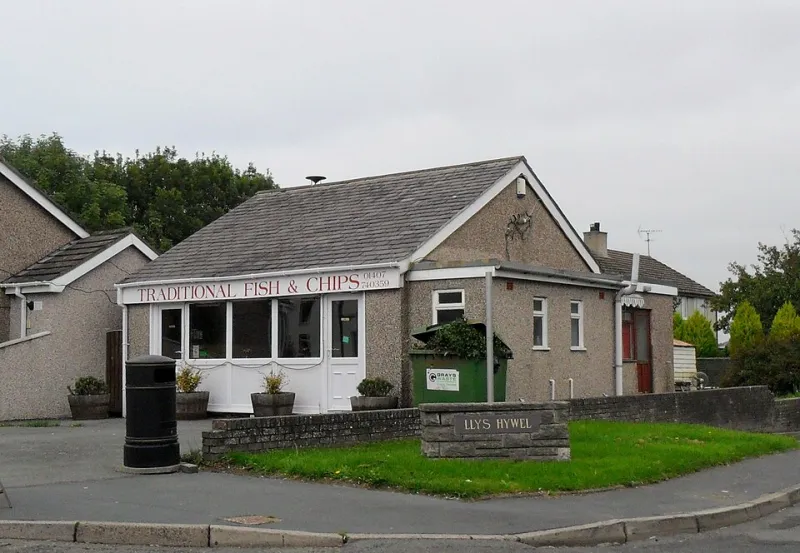
Photo: nick macneill , CC BY-SA 2.0, via Wikimedia Commons
There is a particular shade of green that only exists in a British chip shop at 11pm on a Friday. It's not quite white, not quite yellow, and it does something unforgiving to the human face. Under those tubes, skin goes grey, shadows pool in the eye sockets, and the steam from the fryer hangs in the air like a bad decision. It is, by any conventional measure, terrible light.
It is also, and this is the strange part, the most honest light in British cinema.
The least flattering softbox in Britain
A chip shop is a lighting rig nobody designed. You've got a row of cheap fluorescent tubes overhead, usually with a green spike that no colourist would choose. You've got tiled walls — white, or maybe a faded cream — bouncing light back at the subject from every angle, but never softly. You've got a glass counter, often steamed up, which turns the light into a diffuse glow that only works on the faces of people waiting. And you've got the queue: a line of people standing in the dark outside, lit from within by the window, their breath fogging the glass.
It's a set-up that gaffers spend hours trying to recreate on a soundstage, and almost never get right. Because the chip shop's light isn't just a colour temperature. It's a mood, a texture, a social fact. It says: this is a place where people come after work, after the pub, after a fight. It's not a place for glamour. It's a place for salt and vinegar and the truth.
Why you can't just fake it
I spoke to a gaffer recently — let's call her Cath, because she'd rather not have her name attached to a rant about fluorescent tubes — and she was blunt. 'You can put a green gel on a Kino Flo and call it a chip shop,' she said. 'But it won't look like a chip shop. It'll look like a music video.'
The problem is cleanliness. Film lights are designed to be controllable, consistent, and flattering. Chip shop tubes are none of those things. They flicker. They hum. They have a colour rendering index that makes a haddock look like a warning. And they're mounted in cheap plastic diffusers that yellow over time, which means the light isn't just green — it's green with a history.
Production designers will tell you the same thing. A real chip shop has a patina that a set can't buy. The grease on the extractor hood, the fingerprints on the glass, the way the menu board is slightly crooked. All of that affects how the light lands. You can dress a set to look grimy, but the light will still be too even, too polite. The chip shop is impolite.
A short history of green faces
British cinema has always had a complicated relationship with fluorescent light. The kitchen-sink dramas of the late 1950s and 1960s went looking for it in factories, hospitals and cramped flats. Later, filmmakers like Ken Loach and Andrea Arnold made it a signature — the unglamorous glow of a bus interior, a council estate stairwell, a takeaway counter at closing time.
You can see the lineage in films like Rocks, where the chicken shop scene is lit like a documentary, or Fish Tank, where the fluorescent glare of a flat feels like a form of pressure. These aren't chip shops exactly, but they share the same DNA: light that doesn't care whether you look good.
And then there's the queue. The queue outside the chip shop is one of the great British cinematic images — a row of people standing under a buzzing sign, lit from the window, waiting. It's a social portrait, and it's lit by the place itself. No gaffer needed.
How to shoot it without making an advert
If you're lucky enough to shoot in a real chip shop, here's how not to ruin it.
Use the tubes you've got. Don't replace them with tungsten. Don't add a softbox. Don't try to 'fix' the green in camera. The green is the point. If you must correct it, do it in the grade, and only a little.
Let the counter be the key. The glass counter is a light source, a reflector and a framing device all at once. Put your actor on one side and let the glow come from below. It's unflattering, which means it's interesting.
Keep the steam. Steam is a natural diffuser. It softens the hard edges of the tubes and adds depth to the frame. Don't extract it. Don't fan it. Let it hang.
Shoot wide open. The chip shop is small and the light falls off fast. Embrace the darkness at the edges. A chip shop at night is mostly shadow, with a bright rectangle in the middle. That contrast is the whole story.
Don't shoot the food like a commercial. The moment you do a glossy close-up of a battered sausage, you've lost the truth. The food is not the point. The people are.
Cast real people. This sounds obvious, but a chip shop queue full of extras who've been styled within an inch of their lives will look like a commercial. Real faces, real posture, real impatience.
The honest light
In 2026, British drama is often lit within an inch of its life — soft, warm, flattering, designed to make everyone look like they're in a perfume ad. The chip shop is the antidote. It's a place where the light is harsh, the colours are wrong, and nobody looks their best.
That's why filmmakers keep coming back to it. Because the chip shop doesn't flatter. It reveals. And in a cinema culture that's increasingly obsessed with beauty, there's something radical about a light that says: here you are, then. Warts and all.
So next time you're standing in a queue at 11pm, waiting for a portion of chips, look up at the tubes. That green glow isn't a mistake. It's a lighting philosophy. And it's been teaching British cinema how to tell the truth for decades.