Between the Beams: What a Rotating Lens Still Teaches a Camera
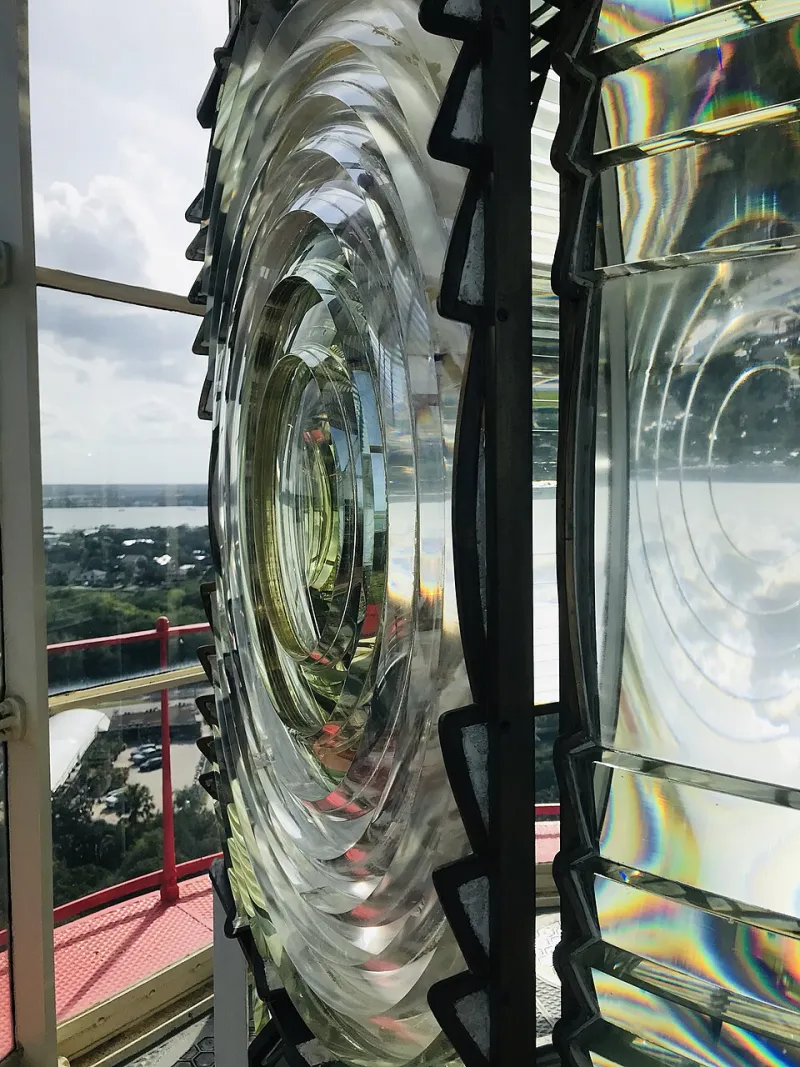
Photo: CynthiaCola, CC BY 4.0, via Wikimedia Commons
At the South Foreland lighthouse, on a clear night, a volunteer will sometimes turn the optic by hand. It is a Victorian thing of brass and concentric glass, and when it moves you feel the room change. Not brighter, exactly. More deliberate. The beam does not flood the sea; it carves a thin wedge through the dark, sweeps it round, and then takes it away again. For a few seconds there is nothing but the clink of the clockwork and the black outside. Then the wedge returns.
That rhythm is the whole point. And it is the thing British cinematographers keep rediscovering whenever they point a camera at the coast.
The Optic Does Not Flood — It Interrupts
A lighthouse lens is not designed to illuminate. It is designed to be seen. The Fresnel prisms bend a small source into a tight, collimated band that can carry for twenty miles or more, depending on the height of the light and the clarity of the air. The characteristic — Fl(4) W 15s, say, or Oc(2) R 10s — is a signature written in time. Four flashes every fifteen seconds. A single occulting light that goes dark for two seconds in every ten. Mariners read the gaps as much as the glare.
Filmmakers tend to arrive at the coast wanting to reproduce the glare. They bring a big source, a bit of haze, and a prayer. What they end up with is a set that looks like a car park with a story attached. The lighthouse is more useful as a model of restraint. It teaches you that a beam is only legible because of what it is not lighting.
A gaffer I spoke to, who has shot two coastal dramas in the past three years, put it simply: 'You don't light the lighthouse. You light the person looking at it, and then you let the lighthouse take the blame.'
A Character Made of Gaps
Every working light around the UK has its own character, maintained by Trinity House in England and Wales, the Northern Lighthouse Board in Scotland, and the Commissioners of Irish Lights around the island. The character is a timetable. It is also a dramatic structure.
Think of the suspense in a good night scene. It rarely comes from a bright thing. It comes from the interval before the bright thing returns. A lighthouse gives you that interval for free: the long dark, the held breath, the sweep of glass catching the eye, the beam arriving late and leaving early. Editors know this instinctively. DPs sometimes forget it because the monitor wants more exposure.
The old keepers knew. A light was not judged by how much sea it showed but by whether a ship could fix its position from the pattern. The pattern is the information. The darkness is the carrier wave.
What It Takes to Shoot There
Location work on a working light is not a case of turning up with a van. There are agreements, insurance, a watchkeeper, and a sensible rule about not pointing anything at the optic. The tide table becomes a call sheet. Salt gets into everything. Generators are noisy, and the wind makes a mockery of a soft box.
A location manager who has worked on the Pembrokeshire coast told me the real skill is in the recce: 'You are not just looking for a lighthouse. You are looking for a place where the dark has somewhere to go. If there is a town behind the camera, you have lost it. If there is a road, you have lost it. You want the black to feel like it continues.'
That is a production problem disguised as a lighting problem. It is also why so many coastal night scenes are shot in the hour before dawn, or in the false dusk of a winter afternoon, when the sky still holds a little blue and the sea has not yet gone fully black. The lighthouse beam reads better against a residual glow. The darkness around it reads deeper because there is something to compare it to.
The Long Wait Is the Scene
The most useful lesson is not about the beam at all. It is about the wait. A rotating optic spends most of its time pointing somewhere else. The audience knows the light is there — they have seen it, they have heard the mechanism — but they cannot see it. That is a very particular kind of tension, and it is hard to manufacture with a dimmer board.
British cinema has always been good at waiting. Fog, rain, net curtains, the half-lit stair: these are all devices for making an audience lean in. The lighthouse is the coastal version. It says: something is coming round again, and you do not know exactly when.
A director I spoke to described shooting a night exterior on the Isle of Lewis with a decommissioned light in the background. They had a permit to dress the lamp, but not to run it. 'We ended up using a small battery-powered unit on a rotator, just to give the actors something to react to,' she said. 'The beam was pathetic. But the rhythm was right. And the rhythm is what the scene was about.'
Bringing the Lesson Indoors
You do not need a lighthouse to use the idea. A practical lamp in a corridor, a torch through a keyhole, a car headlight sweeping a bedroom wall: all of these are miniature rotating optics. The principle is the same. Intermittency creates anticipation. Anticipation creates presence. Presence is cheaper than a 20K and usually more convincing.
It also protects the image. A beam with a hard edge and a long falloff gives the grade something to work with. A big soft source gives you a grey mush that no LUT can rescue. The lighthouse look is not a look, really. It is a discipline: choose the bright thing, protect the black around it, and let the gap do the acting.
The Fifty-First Light
There is a reason this site is called 51st Light. The fifty-first light on any set is the one you leave off. It is the darkness you resist filling, the extra fill you talk yourself out of, the moment you decide the audience can cope with not seeing everything. Britain's lighthouses have been making that argument for two hundred years, in glass and clockwork, at the edge of the map.
They are not romantic because they are bright. They are romantic because they are patient. A beam that arrives on time is a signal. A beam that leaves again is a story. And the best cinematographers, like the best keepers, know that the dark between the flashes is not empty. It is where the next thing comes from.